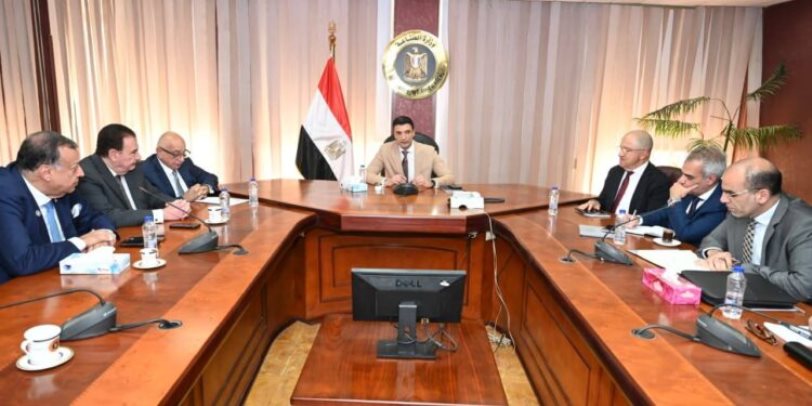
Minister of Industry Khaled Hashem held a meeting with the Federation of Egyptian Industries and the Chamber of Petroleum and Mining to discuss ways to maximize the utilization of mineral raw materials and deepen local industry.
During the meeting, a number of challenges facing the mining industries sector were reviewed, including mechanisms to increase the added value of minerals, reduce the carbon footprint in line with Carbon Border Adjustment Mechanism (CBAM) requirements, the decline in reliance on alternative fuel (RDF) available in the local market due to its low quality, and the limited number of mining exploration licenses currently issued due to the short license duration of one year and the limited areas allocated for exploration.
The meeting also addressed that the mining industries sector is one of the promising sectors prioritized by the Ministry, with the aim of attracting new investments, creating added value, deepening local manufacturing, bridging import gaps, and increasing export rates.
The Minister stated that the Ministry gives significant attention to the Carbon Border Adjustment Mechanism file to enhance the access and competitiveness of local companies in European and global markets, noting that there is strong coordination between the Ministries of Industry, Local Development, and Environment to issue an environmental registry to measure industrial carbon emissions, review data, and verify it.
He added that the Ministry aims to move toward a green economy in the industrial sector and improve operational efficiency to rationalize energy consumption, especially in light of the global energy crisis.
He further stated that the Ministry is currently working, in cooperation with the Ministries of Electricity and Petroleum, on preparing energy maps for each industrial zone, showing the appropriate type of renewable energy (whether solar or wind), to reduce reliance on the national grid, through spreading the culture of energy service companies that review factories’ consumption and identify ways to improve efficiency, in addition to enabling the private sector to establish renewable energy plants and install energy systems in industrial zones.
He added that the Ministry will discuss with the Ministries of Local Development and Environment diversifying sources of alternative fuel that can be used to operate cement factories and energy-intensive industries, noting the Ministry’s readiness to provide support through the Mining and Marble Industries Technology Center affiliated with it.
For his part, Mohamed El-Sewedy, President of the Federation of Egyptian Industries, stressed the importance of benefiting from the services of the Environmental Compliance Office of the Federation, which includes the revolving loan that contributes to financing Egyptian companies, and providing environmental compliance and energy-saving technologies to support the industrial sector in achieving sustainable development goals.